

Why Bitcoin Has Value
And Why That Question Trips People Up

Before we even talk about Bitcoin, we need to talk about money.
Because if you don’t understand what money actually is, Bitcoin will never make sense.
One of the cleanest ways I’ve ever heard it described comes from Jack Mallers:
Money is time and energy, abstracted.
That sounds philosophical, but it’s incredibly simple.
When you work a job, you’re spending your time and your energy.
Money is just the thing you receive that lets you store that effort and use it later.
If money can’t reliably store your time and energy, it’s broken.
This brings us to value.
Why Gold Had Value Long Before Industry
People love to say gold has “intrinsic value.”
That sounds smart, but its just words.
For most of human history, gold wasn’t used for electronics, medicine, or industry.
Those use-cases are very recent.
So ask yourself:
What was gold’s intrinsic value before that?
It wasn’t industry.
And it wasn’t jewelry either.
Jewelry wasn’t the reason gold had value, it was the result of gold already being valuable.
Jewelry was a portable storage mechanism for wealth.
A way to move value across time and distance.
So what actually gave gold value?
Gold had value because:
It was scarce
It was durable
It was divisible
It was fungible
It was hard to produce
But that last point is the key one people miss.
Time + Energy Is the Root of Monetary Value
Gold wasn’t valuable because it was shiny.
It was valuable because it took enormous time and energy to extract.
You had to:
Find it
Dig it
Crush rock
Refine it
Transport it
That process required labor, tools, and energy.
You couldn’t just create gold because you felt like it.
That difficulty made gold a good way to store human effort.
And importantly…
As gold’s price goes up, more gold gets mined.
Higher prices incentivize deeper mines, better technology, and new exploration.
Gold is scarce, but not absolutely scarce.
Bitcoin Starts With the Same Foundation
Bitcoin follows the same rule, but improves it.
Bitcoin is valuable because it also requires time and energy to create.
Mining isn’t just computers “printing money.”
Miners must:
Buy hardware
Pay for electricity
Compete with the rest of the world
Follow strict rules enforced by the network
If they break the rules, their work is rejected.
Bitcoin doesn’t care who you are, where you live, or how powerful you think you are.
Rules are rules.
Quick pause.
If this article is helping, and you want a simple place to start, I wrote a short book called Getting Off Zero.
It walks through what Bitcoin is, how to buy a small amount safely, and how to hold it yourself, step by step, without technical language.
It’s available on Amazon and Gumroad.
In the Beginning, Bitcoin Had No Price
Bitcoin didn’t start with a price tag.
In the early days, Bitcoin was mostly exchanged between hobbyists and cryptographers.
Its “value” was roughly tied to electricity costs.
If it cost you $0.10 in electricity to solve a block, that became a rough floor for the price.
But then something happened.
The Pizza That Changed Everything

In May 2010, someone used Bitcoin to buy something in the real world.
Two pizzas.
10,000 bitcoin.
That wasn’t stupid.
It was necessary.
That transaction anchored Bitcoin to reality.
It proved Bitcoin could move value between people without permission.
From that moment on, Bitcoin wasn’t theoretical anymore.
It had officially become money.
Energy, Scarcity, and Why Bitcoin Is Different
Bitcoin takes time and energy to produce, just like gold.
But here’s the difference that changes everything:
Bitcoin has a fixed supply.
There will only ever be 21 million bitcoin
No matter the price
No matter the demand
No matter who wants more
When Bitcoin’s price rises, you don’t get more Bitcoin.
You get more competition for the same fixed supply.
Gold can respond to price with supply.
Bitcoin cannot.
That makes Bitcoin the hardest money humans have ever created.
“What Is Bitcoin Backed By?”
This is the question everyone asks.
Bitcoin isn’t backed by gold.
It isn’t backed by a government.
It isn’t backed by force.
Bitcoin is backed by:
The most secure computer network ever created
Millions of independent nodes enforcing rules
Real-world energy costs
Math that anyone can verify
A supply schedule no one can change
That’s what backs Bitcoin.
Not promises.
Not trust.
Not politics.
A Prediction That Sounded Insane (Until It Didn’t)
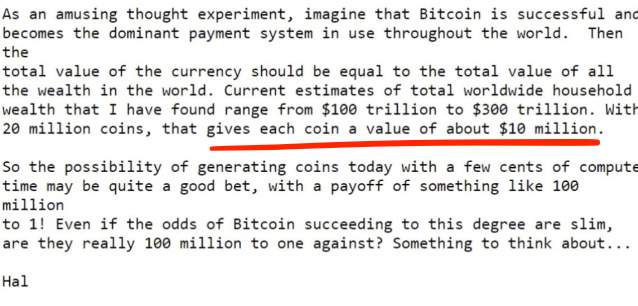
Bitcoin contributor Hal Finney once speculated that if Bitcoin succeeded as global money, each coin could be worth $10 million.
At the time, Bitcoin traded for pennies.
That prediction wasn’t moon boi hype.
It was math.
If Bitcoin absorbed even a portion of:
Gold
Bonds
Global savings
Store-of-value demand
The numbers get very large very fast.
Whether that future happens or not is still unknown.
But the logic behind the valuation is sound.
Why This Question Is So Hard for Beginners
People struggle with Bitcoin’s value because:
We’re trained to think money must come from authority
We confuse “physical” with “valuable”
We’ve never seen digital scarcity work before
Bitcoin challenges that way of thinking.
It shows that value comes from rules, energy, and trustless verification, not rulers.
One last thing.
If you understand Bitcoin better now but still feel unsure what to do next, I offer one-on-one calls to help you think it through.
We talk about your situation, your questions, and what makes sense for you!
If that would be helpful, you can book a call below.
Stay Sovereign
-B!t Doug
Thanks, Bit Doug, I learned something here. Good article.
I've been a big fan of bitcoin for a while, thanks for the clean description of it.